
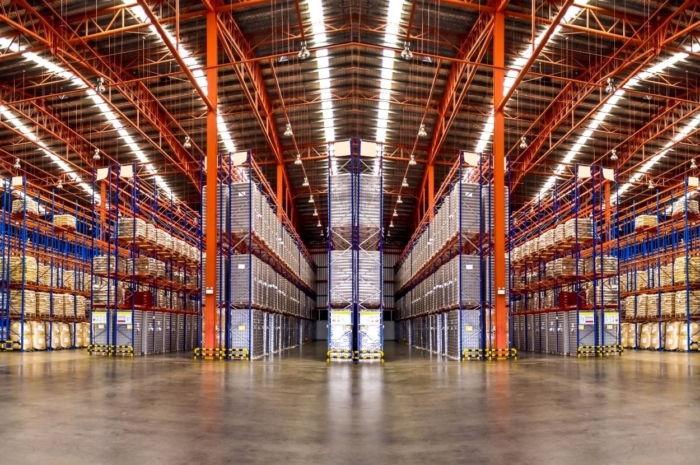
29 CFR 1910.176, "Handling materials — general," is the section most often quoted at warehouse operators and most often quoted wrong. It's short, and it's almost entirely performance-based. Which is exactly why people remember it as containing rules it has never contained.
Here's what's actually in it.
What the section says
1910.176(a), Use of mechanical equipment. Where mechanical handling equipment is used, sufficient safe clearances have to be allowed for aisles, at loading docks, through doorways, and anywhere a turn or a passage has to be made.
Now look at what isn't there: a number. This subsection doesn't specify an aisle width. There's no federal "aisles must be 12 feet" rule, and if someone quotes you one from 1910.176, they're quoting something else. "Sufficient safe clearance" gets judged against the equipment you actually run. A reach truck and a counterbalance truck in the same aisle give you different answers, and so does a double-pallet handler.
That's harder than a fixed number, not easier. You have to be able to explain why your clearances are sufficient for your trucks and your loads.
1910.176(b), Secure storage. Storage of material must not create a hazard, and material stored in tiers has to be stacked, blocked, interlocked and limited in height so it's stable and secure against sliding or collapse.
This is the workhorse for warehouse storage, and it's broad on purpose. "Shall not create a hazard" is what lets an inspector write up an overloaded rack, a leaning stack, a bay with a damaged upright still in service, or product stacked so it'll come down the moment someone disturbs it.
1910.176(c), Housekeeping. Storage areas kept free of accumulated materials that create hazards from tripping, fire, explosion, or pest harborage.
Read that one twice, because fire is named directly. Accumulated packaging, pallet stacks against uprights and general aisle clutter are a housekeeping finding and a fire loading problem at the same time.
1910.176(e), Clearance limits. Signs warning of clearance limits have to be provided.
1910.176(f), Rolling railroad cars. Derails and/or bumper blocks on spur tracks where a rolling car could reach cars being worked, a building, or a work or traffic area.
1910.176(g), Guarding. Covers and/or guardrails to protect people from open pits, tanks, vats and ditches.
(There's no 1910.176(d). It's reserved.)
Where rack citations really come from
Here's the part that surprises people. There's no OSHA standard specific to industrial steel storage racks: no rack design standard, no mandated inspection interval, no rack section to look up. And none of that makes rack unregulated in the slightest.
Findings generally arrive through one of three doors:
- 1910.176(b), when damaged, overloaded or unstable racking gets treated as storage that creates a hazard.
- The General Duty Clause, Section 5(a)(1) of the OSH Act, requiring a workplace free from recognized hazards likely to cause death or serious physical harm. This is the tool for hazards the industry plainly recognizes but no specific standard addresses, which describes rack collapse pretty well.
- Consensus standards, used as evidence of recognition. ANSI MH16.1, the design, testing and utilization standard for industrial steel storage racks, isn't an OSHA regulation. But it is the recognized industry standard, and "the industry standard says X and you didn't do X" is how a General Duty Clause case gets built.
So designing and maintaining rack to MH16.1 isn't optional just because it isn't a regulation. It's the thing that demonstrates you met the recognized standard of care.
The sections people conflate with this one
Three that come up constantly in warehouse conversations and actually live elsewhere in the rule:
- Fall protection duty is 1910.28. Fall protection system criteria is 1910.29. If you've got a spec sheet citing 1910.23 for guardrails or gates, it's out of date. Before the Walking-Working Surfaces final rule took effect in January 2017, 1910.23 was "Guarding floor and wall openings and holes." Today 1910.23 is Ladders. Plenty of manufacturer literature still carries the old number.
- Guardrail height is 1910.29(b)(1): 42 inches, plus or minus 3, from the walking surface to the top rail. Height alone doesn't make a system compliant. The same subsection also covers midrail, strength, opening and surface-finish criteria.
- Falling object protection is 1910.29(k), which is the relevant hook for toeboards. Rack netting, safety straps and mesh backing support it rather than satisfying it single-handedly.
Turning requirements into hardware
Most of 1910.176 is procedural: how you stack, how you route trucks, how tidy you keep the place. But a few pieces respond well to physical fixes, and those are the ones that stop depending on everybody having a good day.
- Protecting clearances that keep getting violated. If the aisle is "sufficient" only when nobody cuts the corner, column guards, end-of-aisle protection and guard rail are what make it real. See rack protection and warehouse protection.
- Keeping stored material from sliding or falling into aisles. Straight 1910.176(b) territory, and where rack fall protection (netting, mesh backing, safety straps) does the work.
- Separating people from trucks at doors, docks and crossings. Dock and door safety covers the loading dock end.
None of that replaces the procedural half. Guard rail doesn't fix a stacking practice, and no amount of hardware makes an overloaded beam safe.
Related reading
Inspection cadence is in how often to inspect your pallet rack. The fire code side, which is NFPA 13 rather than OSHA, is in in-rack flue space.
Got a specific finding you want matched to a fix? Send it over.