
A ceiling sprinkler can't put out a fire it can't reach.
That sounds obvious until you think about where rack fires actually start. Not at the top. Somewhere in the middle of a loaded bay, three levels up, with pallets above it and pallets on either side. The only way water gets down there is through the vertical gaps between the loads. Those gaps are your flue spaces. Keep them open and the sprinkler system does roughly what it was designed to do. Close them up and you've built a chimney with a lid on it.
This is also the thing we get called about most after a fire marshal walks a building. So it's worth understanding properly instead of treating it as one more box on an inspection form.
Transverse and longitudinal, and why people mix them up
There are two of them, and they get swapped in conversation constantly. We had them backwards in our own FAQ until an audit caught it, so we're not going to pretend this is obvious.
Transverse flue space runs between loads and at the rack uprights, parallel to the direction you load from. Stand in the aisle and look at a bay: those vertical slots you can see between one pallet and the next, and at each upright, are your transverse flues. Every rack has them.
Longitudinal flue space is the gap between back-to-back rows, running the length of the rack. Two rows pushed together, forklifts loading from opposite aisles, and a space down the middle. That's the longitudinal flue. Single-row racks don't have one at all. There's no back-to-back loading, so by definition there's nothing to keep open.
Easy way to remember it: transverse flues you can see from the aisle, longitudinal flues you can't.
What NFPA 13 asks for
Some context before the numbers. What follows are the general rack storage provisions, and your actual requirement depends on commodity class, storage height, rack configuration, and what sprinkler scheme protects the building. NFPA 13 also gets revised every three years, and the 2019 edition moved the storage chapters around substantially. Work from the edition your jurisdiction has adopted, not from a number somebody quoted you in 2015.
Transverse flues: nominal 6 inches. This one's consistent. Single-, double- and multiple-row racks, the ordinary commodity classes and plastics and rubber, above and below the 25 ft storage height break. All of it comes back to nominal 6 in. transverse flue spaces between loads and at the uprights. If you only remember one number, remember this one.
"Nominal" is doing real work in that sentence. It means designed and built to 6 inches, not policed to the sixteenth of an inch. It also isn't permission to run 3 inches and call it close enough.
Longitudinal flues: it depends. This is where sites get caught out, because the answer genuinely changes with the setup:
- Single-row racks. None required, as above.
- ESFR sprinklers. Not required, whatever the height. ESFR is built to drive water down through the storage rather than lean on the flue network the same way.
- Double- and multiple-row racks up to and including 25 ft, without solid shelves. Generally not required.
- Double-row racks over 25 ft. A nominal 6 in. longitudinal flue is called for.
- Multiple-row racks over 25 ft. Governed by configuration-specific figures in the standard. No clean rule of thumb here, and we won't invent one. That's a conversation with a fire protection engineer.
There's a width angle on the longitudinal side too. The standard frames it as the space between rows of storage with a width not exceeding 24 in. Open that back-to-back gap up far enough and it stops behaving like a flue and starts behaving like a second aisle, which changes the analysis.
You can screen your own arrangement with our flue space calculator. It walks the same ruleset and shows you which provisions matched. Be clear on what it is, though: a screening tool, not a design. No sprinkler hydraulics, no commodity classification. A licensed fire protection engineer needs to confirm anything you build from it.
Why flues close up
Nobody sets out to block a flue space. It happens because of how warehouses actually run.
- Pallet overhang. The load is deeper than the pallet, or deeper than the rack. An inch or two on each side quietly eats your transverse flue.
- Push-through. An operator shoves a pallet into a double-row bay from one side and drives the load already sitting there into the longitudinal flue, or straight through it. This is the big one. It's also invisible from the aisle the driver is standing in, which is why it survives so long.
- Undersized pallets. A 40x48 load on a rack laid out for something else, or three pallet sizes mixed across the same bay. You end up with gaps in the wrong places and none in the right ones.
- Slotting drift. A bay laid out cleanly in year one is a mixed-depth mess by year three. Nobody decided that. It just happened, one SKU change at a time.
- Stretch wrap and slip sheets. Wrap tails and overhanging sheets weigh nothing and block a flue about as well as cardboard does.
Every one of those has the same shape. The flue space was correct the day the rack was commissioned, and then operations closed it. Which is why this is an inspection item and not a one-time design item.
Keeping them open
The fix is a physical barrier that stops the load before it reaches the flue, instead of asking a driver to judge depth from the seat of a forklift.
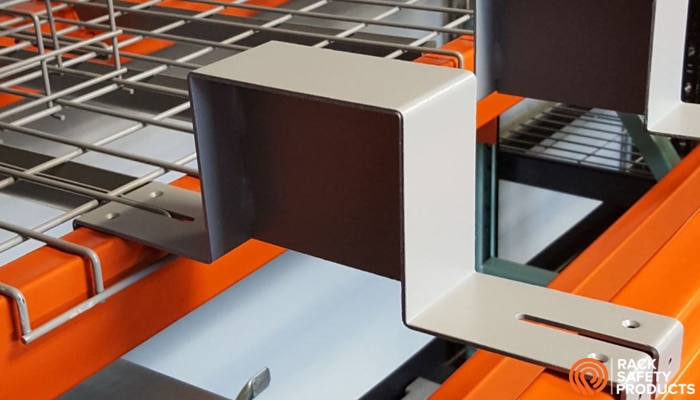
Flue Keepers sit at the uprights and hold the transverse flue open. They give the load something to stop against, so the gap at each upright survives contact with a pallet. Flue Guards handle the longitudinal flue in back-to-back racks, stopping push-through from either side and keeping that centre gap where the sprinkler design assumed it would be.
Both are engineered to the rack rather than universal, and that matters more than it sounds. Beam type, beam depth and the offset you need all vary by manufacturer. A divider that doesn't match your beam profile either won't install or won't hold. Our flue products page has the range, and if you already know your dimensions there's an interactive Flue Guard spec sheet.
While we're here, a couple of things that aren't fixes. Wrapping loads tighter doesn't create a flue. And painted lines on the deck telling drivers where to stop work exactly as well as painted lines ever work.
What an inspector actually looks at
When a fire marshal or an insurance surveyor walks rack storage, the flue review is usually quick and visual:
- Sight down the transverse flues from the aisle. Are they continuous top to bottom, or do loads close them at certain levels?
- Check the back-to-back gap on double-row racks for push-through.
- Look for overhang past the beam face and past the rack depth.
- Check whether decking is blocking vertical water travel. Our guide on decking and fire compliance covers this, because a deck that isn't open enough turns your open rack into solid shelving as far as the standard is concerned.
- Spot-check that the flue arrangement still matches what the sprinkler design assumed. This is the one that catches people after a re-slot or a rack reconfiguration, when nobody thought to go back and check the fire side.
If you already have a finding
Of all the things a marshal can hand you, a flue space citation is one of the more fixable. The rack usually doesn't need to come out. It needs dividers specced to the beam profile you actually have, installed at the levels that are failing, and sometimes a slotting change so your loads stop fighting the flue.
If you're holding a finding and want it scoped, send us the details. Photos of the bays in question, your beam manufacturer and profile, and the storage height are enough to get started.