
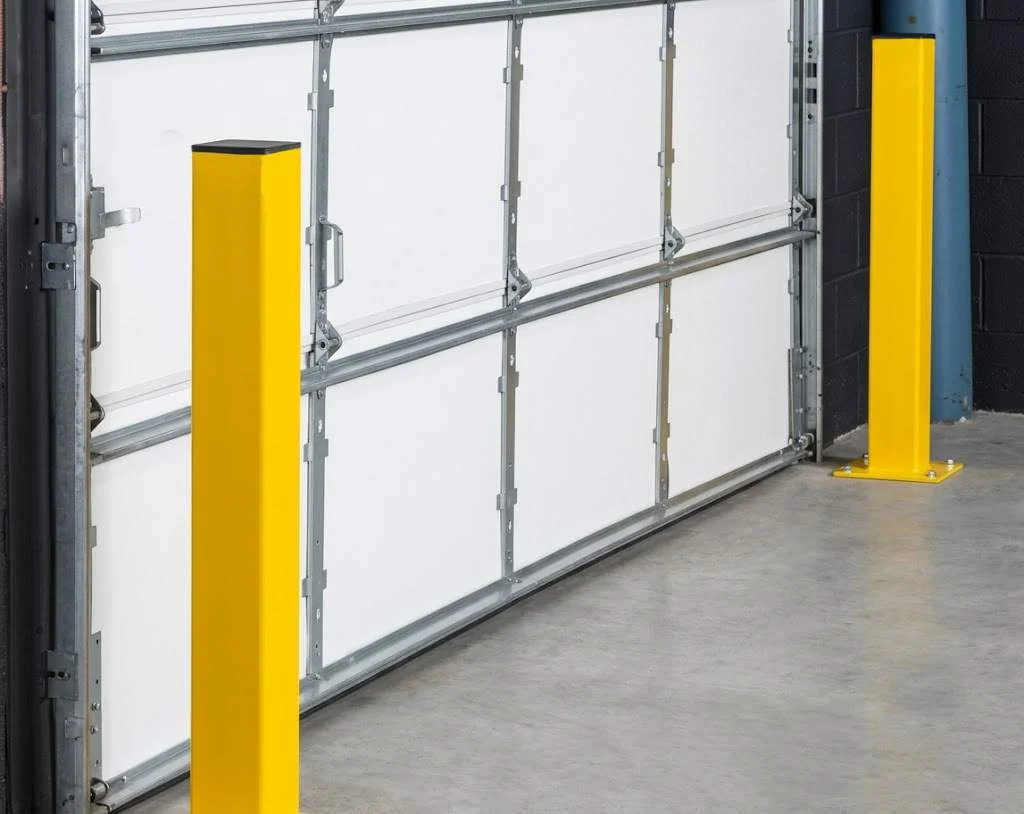
A bollard is one of the simplest pieces of protection in a warehouse: a steel or polymer post that stands between a forklift and something it must not hit. Dock door frames, rack ends, electrical panels, office corners and pedestrian doorways are where they usually go.
How well it works depends almost entirely on how it is fixed to the floor. The post is rarely what fails. The anchors are, or the slab around them.
There are two ways to put one in. Which one you choose decides most of the job.
Bolted down or buried
Surface-mount bollards stand on a steel base plate that is anchored to the top of an existing slab. No digging, no new concrete, and the post can be unbolted and moved later. WWMH describes its bollard as "designed for easy floor anchoring without the need for concrete work", and makes the point that bolt-down bollards install faster and with less labour than embedded ones, and suit facilities that expect to reconfigure their layout.
Direct-bury bollards have no base plate. The post goes down into a hole and is set in concrete, so the ground holds it rather than four anchors. Save-ty, which makes the direct-bury bollards we carry, describes them as installed "for heavier impacts".
The trade-off is in the anchors. As Save-ty puts it, with a surface-mounted steel bollard "you're relying more on the strength of the wedge anchors". Indoors, against forklift traffic, that is normally what you want: fast to fit and easy to replace. Outdoors, on dock approaches, at gate posts and anywhere yard traffic can hit hard, a direct-bury bollard is the stronger choice.
A polymer bollard is a third option, and installs like a surface-mount one. It flexes on impact and comes back to shape rather than resisting rigidly, which puts far less of the strike into the anchors and the slab.
Before anyone drills
The slab is the foundation. WWMH's own advice is to check that the floor has "sufficient thickness and integrity to support the mounting system", because with a surface-mount bollard "the concrete floor acts as the entire foundation for the safety system". The surface should be level and free from cracks that could weaken the anchors.
What none of the manufacturers we work with publishes is a number: no minimum slab thickness, no minimum concrete strength. That is not an oversight you can fill in with a rule of thumb. It depends on the anchor, the slab and the hit you are designing for, so ask the bollard maker, and if there is any doubt about the floor, have it looked at by someone qualified to judge it.
Know what is in the slab. Before drilling, find out whether the floor carries anything you could hit: post-tensioned tendons, in-floor heating, buried conduit. The building owner's drawings are the first place to look. If nobody knows, find out before the drill comes out, not after.
Plan for the dust. Drilling concrete makes silica dust. A-SAFE's installation instructions say to assess the risk before drilling, keep dust down with water, extract it at the tool with a HEPA-filtered vacuum, and wear respiratory protection rated APF 20 or above if the dust cannot be fully controlled.
Installing a surface-mount bollard
The sequence is the same for any bolt-down bollard. A-SAFE's picture guide for its iFlex bollard shows it step by step:
- Stand the bollard in position and mark the floor through the base plate holes.
- Drill the anchor holes to the anchor manufacturer's diameter and depth.
- Clean the holes out. A-SAFE's sequence vacuums them before the anchors go in.
- Set the anchors and fix the bollard down.
- Tighten to the anchor manufacturer's torque with a torque wrench.
The bollard makers specify the anchor size and count. They do not publish a torque or an embedment depth, because those belong to the anchor, so take them from the anchor manufacturer's installation data.
What each bollard we carry calls for:
| Bollard | Base plate | Anchors |
|---|---|---|
| Bollards (WWMH) | 10″ × 10″ × 1/2″ | Four holes, taking 3/4″ or 1/2″ anchors |
| Square Steel Safety Bollards (Wildeck) | 10″ × 10″ × 3/8″, drilled 5/8″ | Four 1/2″ anchors recommended, not included |
| Polymer Safety Bollards (A-SAFE iFlex) | Coated steel base | Four through-bolt anchors, per A-SAFE's install guide |
Save-ty, whose wider range includes surface-mount steel bollards, recommends a 5/8″ × 4-3/4″ wedge-style anchor for them, and slots the base plate holes so a replacement bollard can go back on existing anchors.
Should you fill it with concrete?
You can fill a surface-mount steel bollard with concrete, and Save-ty says it helps stop a fork blade punching through the pipe in a straight-on hit. It does not change what holds the bollard down: that is still the anchors.
Installing a direct-bury bollard
The direct-bury bollards we carry are 84″ long, in 5.5″, 6.5″ and 8.5″ outside diameters. Save-ty makes them that length so you can set 42″ above ground and 42″ below, and says you can bury them deeper if you want. A direct-bury bollard is always filled with concrete.
Beyond that, the manufacturer publishes no hole diameter, footing size, concrete mix or curing time. Those are site decisions: soil, frost depth, whether you are coring an existing slab or pouring new, and what the bollard has to stop. Have whoever is doing the concrete work set them for your site.
Where to put them
Bollards go where a truck can reach something it should not: dock doors, rack ends, pedestrian routes, control panels and equipment. A few things are worth getting right while you are planning the positions:
- Match the height to the vehicle. A-SAFE points out that the impact zone matters as much as the impact rating, and that a low bollard a pedestrian can see may be invisible from a forklift seat.
- Leave room for a polymer bollard to move. A-SAFE rates its iFlex bollard to lean up to 15° at maximum impact energy. Whatever it protects needs to be outside that lean.
- No maker publishes a spacing or setback distance. Space them to the narrowest vehicle or load you are trying to stop, and keep a walkway gap where people need to get through.
After they are in
A loose bollard gives very little protection, and anchors loosen over time from repeated small hits and floor movement. WWMH recommends inspecting bollards quarterly for signs of impacts, cracks, rust and loosening, and fixing anything loose straight away.
Once the paint is chipped and the yellow has faded, the bollard is doing less to warn drivers. Bollard covers slide over an existing bollard to restore the colour without repainting.
To compare the bollards themselves, surface-mount, direct-bury and polymer, see safety bollards.